

People looking for legal help need to understand who you can assist, where you practise and why they can trust your information. A useful law-firm SEO strategy makes those answers easy to find, then provides a clear route to an appropriate enquiry.
Visibility can begin with a Google search, a map listing, a directory or an AI-assisted comparison. Your website should give a consistent account of the firm across those journeys, supported by accurate practice information and content reviewed by the right people.
What does SEO do for a law firm?
Search engine optimisation helps search engines discover and understand your pages and helps potential clients find relevant information. For a law firm, the goal should be suitable enquiries for the work you actually handle, rather than traffic from every legal question.
Organic search does not charge you each time someone clicks a standard listing. It still requires investment in content, website maintenance and staff time. SEO is not free advertising, and rankings do not guarantee that a visitor will become a client.
Start by identifying the practice areas and locations that matter to the firm. A dispute-resolution practice, a family-law team and a corporate advisory firm may need different content and enquiry processes. The plan should reflect those differences.
1. Match each page to a real client need
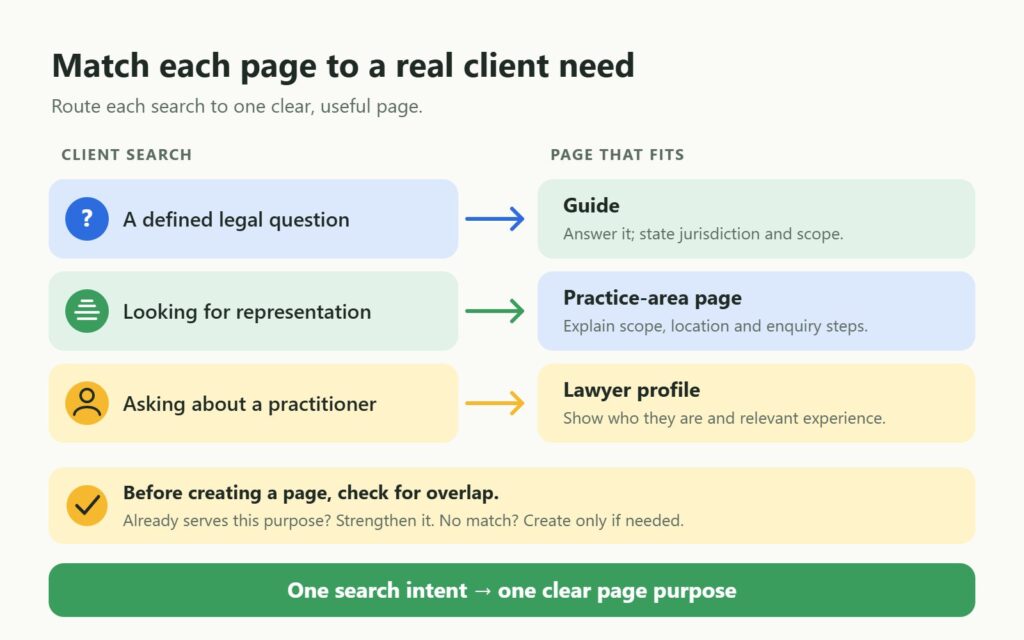
Separate informational searches from searches for representation. Someone asking what a legal term means needs a clear explanation. Someone looking for a lawyer in a specific city may need information about scope, experience, location and the consultation process.
Map a primary purpose to each substantial page. A practice-area page should explain the matters the team handles. A lawyer profile should establish who the practitioner is. A guide should answer a defined question within a stated jurisdiction.
Use the language prospective clients understand, then explain the necessary legal terminology. Do not fill a title or heading with every variation of “lawyer,” “attorney” and “law firm.” Natural wording helps a visitor recognise whether the page fits their situation.
Before creating another page, check whether an existing one already serves the same purpose. Strengthening a useful practice page can be more valuable than publishing several overlapping introductions.
2. Build substantive practice-area pages
Give each core service enough detail for someone to assess relevance. Explain who the service is for, the kinds of matters covered, the process for making an enquiry and which team members handle the work.
Use concrete questions as an editorial brief: What happens after contact? Which information is needed initially? Does the team handle individuals, businesses or both? Which languages and locations can it support? Publish only details the firm has confirmed.
An employment-law page, for example, should make clear whether the team works with employers, employees or both. A general claim to “solve every employment problem” tells a visitor less than a careful explanation of the firm’s scope.
Where fees vary, explain how a prospective client can learn about the relevant arrangements. Avoid invented prices, blanket outcome promises or claims of specialist status that the firm has not substantiated and approved.
Give the page a descriptive title, a clear H1 and headings that follow its purpose. Link to relevant lawyer profiles and genuinely useful guides. Each link should help the reader take the next sensible step.
3. Make experience and responsibility visible
Legal information can influence decisions with serious consequences. Google’s people-first content guidance emphasises trustworthy sourcing, expertise and clear authorship, especially for consequential topics. It also states that E-E-A-T is not a standalone ranking factor.
Identify the author or reviewer of substantive legal content and connect that name to a useful profile. State genuine qualifications, admissions and practice experience accurately. A byline should identify responsibility rather than act as a decorative badge.
Use primary legal sources where appropriate and explain which jurisdiction the article addresses. Establish a review process with a suitably qualified practitioner. This is an editorial control for accuracy, not a substitute for advice on an individual matter.
Show evidence of the firm’s work only where disclosure is appropriate and approved. Do not publish confidential details, client identities or case documents merely to create a stronger story. Review testimonials and promotional claims against the professional rules relevant to the firm.
4. Maintain an accurate local presence
Google identifies relevance, distance and prominence as the main considerations in local rankings. These are published principles, not speculative tricks that guarantee a place in the map results.
For an eligible Google Business Profile, use the firm’s real-world name and accurate business information. Keep contact details, hours and website links current. Choose appropriate categories rather than adding promotional keywords to the business name.
Check eligibility before creating separate profiles for offices or individual practitioners. Google has specific rules for practitioner listings and business locations. Do not assume a rented mailing address or virtual office establishes an eligible staffed location.
On the website, provide practical office information: address, contact routes, access details and appointment arrangements where relevant. For several genuine offices, explain what each location offers rather than repeating the same page with a city name changed.
Repeating a genuine address in a footer is not, by itself, a reason to hide it for fear of duplicate content. Concentrate on accurate information and useful location pages. Listing a place name does not guarantee visibility for searches from that area.
5. Publish legal guides with a maintenance plan
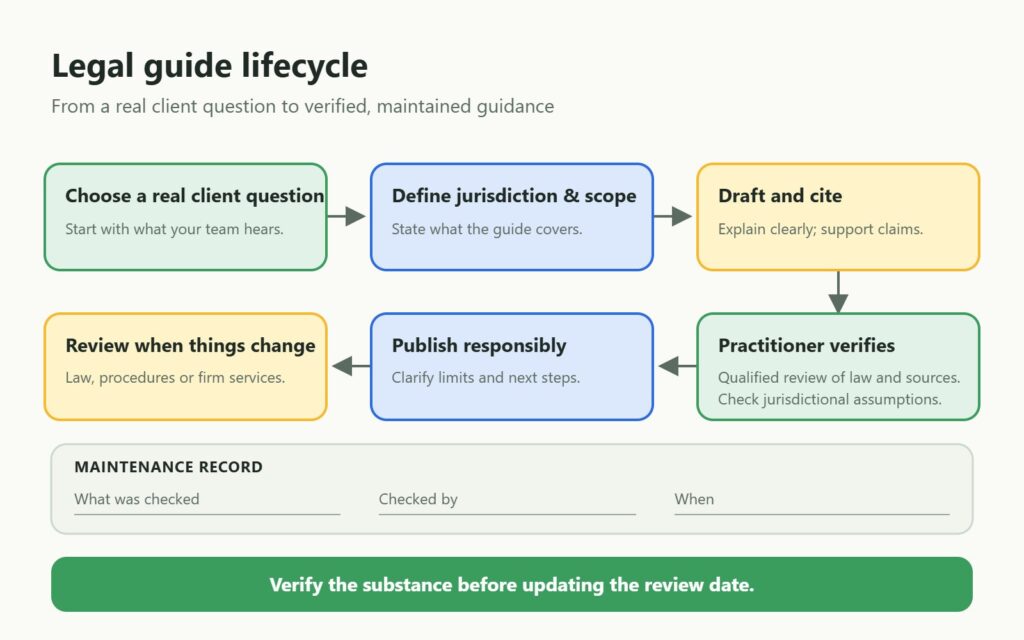
Choose topics from the questions your team regularly explains to prospective clients. A focused guide can clarify an issue and help someone decide whether to seek professional assistance.
State the jurisdiction and scope near the start. Explain unfamiliar terms, distinguish general information from individual advice and make the next step clear. Where the answer depends on facts you do not have, say so rather than presenting a universal answer.
Assign responsibility for reviewing the page when relevant law, procedures or the firm’s services change. Update the substance before changing the review date. Maintain a record of what was checked, by whom and when.
An article does not become useful merely because it is long. Organise the explanation around the reader’s question. Examples should clarify a principle without implying a guaranteed outcome or inventing a real client history.
AI can help organise a brief or identify passages that need checking. A qualified reviewer should verify legal statements, citations and jurisdictional assumptions before publication. Fluent wording can still contain a serious error.
6. Check technical access and mobile usability
Google’s SEO Starter Guide explains the need for discoverable, accessible content. Check whether important public pages can be crawled and indexed, and whether internal links lead to the intended destinations.
Review broken links, redirects, canonical URLs and accidental indexing restrictions. If the firm has a client portal or confidential material, keep its access controls separate from decisions about public marketing pages.
Test the site on a phone. Read the service explanation, open the navigation, use the contact links and submit a test enquiry. Confirm that the right team receives it and that the confirmation sets an accurate expectation.
A fast page with an unclear offer still creates friction. Review readability, forms and navigation together. Ask someone unfamiliar with the firm to find the relevant team and explain what would happen after contacting it.
7. Earn genuine reviews and relevant references
Ask for honest feedback about a real experience where appropriate under the firm’s policies and professional obligations. Google Maps prohibits fake engagement and incentives for reviews. Do not reward positive ratings or selectively solicit only favourable feedback.
Plan how the firm will respond without discussing confidential matters in public. A critical review should trigger an internal assessment, not a defensive disclosure of a client’s situation.
Check relevant professional directories and business listings for accurate details. Seek useful references through legitimate professional activity, resources or commentary. Avoid buying links intended to manipulate rankings or creating networks of thin sites.
Treat third-party profiles as maintained business information. Old telephone numbers, inaccurate practice descriptions and inconsistent lawyer details can confuse someone who is comparing firms.
8. Prepare for AI-assisted discovery
Google says its existing SEO practices remain relevant to AI Overviews and AI Mode, with no special additional optimisation required. A supporting page must meet the relevant search eligibility requirements, and inclusion is not guaranteed.
Other AI assistants may use different sources and retrieval methods. Avoid promises that a particular file, keyword pattern or schema will make every chatbot recommend the firm.
Make the firm’s identity, practice areas, locations and practitioner information clear. Keep substantial answers available as readable text, with useful headings and supporting references. Review important third-party profiles alongside your own pages.
If an assistant mentions the firm, examine the context and accuracy. A citation, a brand mention and a referral that becomes an enquiry are different observations. Keep that distinction when reporting visibility and consider our AI Services to help align your brand with your LLM of choice.
9. Measure enquiries that fit the practice
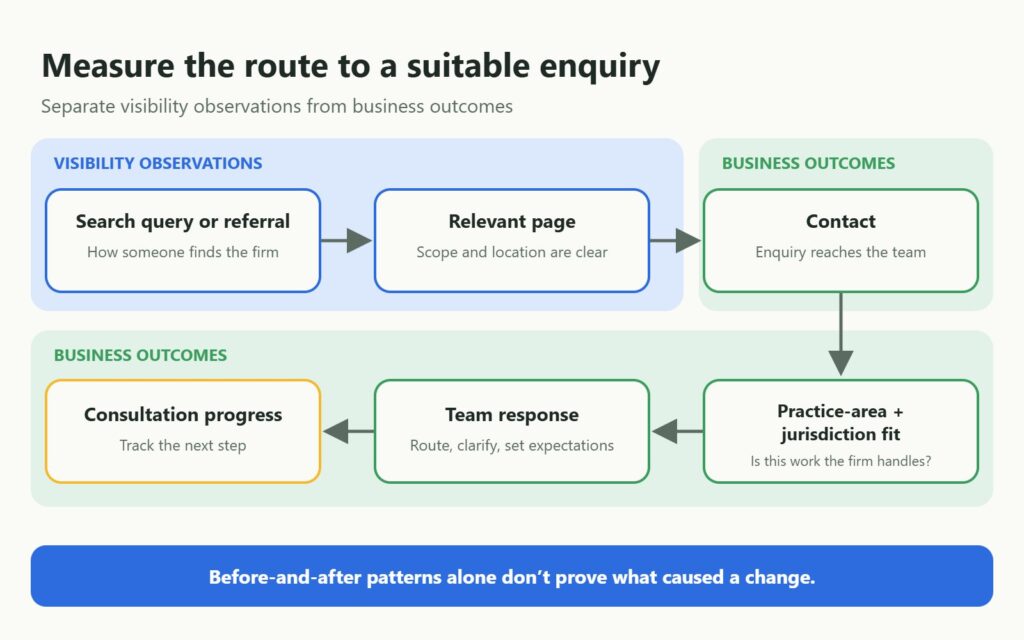
Use Search Console to investigate queries and pages where data is available. Separate branded searches, informational topics and searches for the services you want to provide. A change in average position alone does not explain a change in business outcomes.
Combine website observations with an appropriate enquiry record. Track whether contacts concern the right practice area and jurisdiction, whether the team responds and whether consultations progress. Keep sensitive case information out of routine marketing reports.
Set a baseline and record substantial changes. A before-and-after comparison can reveal a pattern, but cannot by itself prove what caused it. Review the full path from discovery to a suitable enquiry.
Turn the review into a focused improvement plan
Start with the pages closest to the matters your firm wants to handle. Check their accuracy, contact journey and visibility before expanding the publishing schedule. Give each improvement an owner and a way to verify completion.
If the cause of weak performance is unclear, an SEO audit and analysis can help identify whether access, structure, content or the enquiry journey needs attention first. Use the findings to prioritise work rather than treating every recommendation as equally urgent.
For firms whose clients search by area, local SEO support can focus on the relationship between genuine offices, website location information and business profiles. The aim is a more accurate, useful local presence, rather than a promise to overcome the searcher’s distance.
When practice pages do not clearly explain the offer, on-page SEO can help align titles, headings, internal links and substantive content. The firm’s lawyers should remain responsible for approving legal accuracy and claims about the service.
A practical first 90 days
First month: verify the foundations
Confirm the priority practice areas, real office information and enquiry process. Review the main service pages with the relevant practitioners. Test forms and contact routes, and establish a consistent way to record suitable enquiries.
Second month: improve the most useful pages
Resolve the most consequential technical issues and strengthen a small set of practice pages. Add clear profiles and relevant supporting guides where information is missing. Update important listings to match verified business facts.
Third month: review outcomes and ownership
Review suitable enquiries and the quality of the new content. Check whether the team can maintain the pages it has published. Refine the next set of improvements from evidence, recognising that search visibility and client decision cycles can take longer to evaluate.
Choose support that understands the firm’s priorities
An agency brief should specify the practice areas, locations, audience and type of enquiries you want. Agree on who writes, who reviews, who controls the accounts and how progress will be reported. Retain ownership of the firm’s website and business profiles.
TBS Marketing’s legal marketing services provide a relevant starting point for discussing that work. Bring the firm’s objectives and current constraints so the conversation can focus on the right combination of visibility, content and conversion improvements.
Choose one practice-area page today. Can a prospective client tell whom it helps, where the team practises, who is responsible for the advice and how to make an appropriate enquiry?