
Artificial Intelligence (AI) in SEO can be defined as the use of machine learning models, large language models (LLMs), and automation systems to analyze search data, generate content, and influence how information is retrieved and displayed in search engines. Over the past two years, AI-powered features such as Google’s AI Overviews and conversational search tools have significantly reshaped how users discover information online.
According to multiple industry studies, AI-generated summaries now appear in nearly half of all search results, while zero-click searches continue to rise. This article explores what AI can and cannot replace, how SEO is evolving, and what a realistic future for search optimization looks like.
What Is SEO in the Age of AI?
SEO in the age of AI refers to the strategic process of optimizing websites and content not only for traditional ranking algorithms, but also for AI-driven search experiences such as generative answers, summaries, and chat-based interfaces.
In its simplest form, SEO still aims to improve visibilityin search results. However, AI has expanded the scope of SEO to include:
- Optimization for AI-generated answers
- Structured content that machines can interpret easily
- Intent-focused and context-rich writing
- Brand authority and topical trust signals
While traditional SEO focused heavily on keywords and backlinks, modern SEO increasingly emphasizes meaning, relevance, and credibility.
How AI Is Transforming Search Engines
AI is fundamentally reshaping how search engines retrieve, rank, and display information.
AI-Powered Search Results
AI-generated summaries now appear directly on search engine results pages (SERPs), reducing the need for users to click through multiple links. Industry data from SEO analytics platforms shows that AI summaries now appear in nearly half of informational search queries, contributing to the rise of zero-click searches.
In practical terms:
- Users get answers faster.
- Websites receive fewer clicks even when ranking highly.
- Search visibility is no longer limited to blue links.
What SEO Tasks AI Can Replace (and Already Has)
AI can replace or significantly automate repetitive, rules-based SEO tasks, especially those that rely on pattern recognition rather than strategic judgment.
Common SEO Tasks AI Handles Well
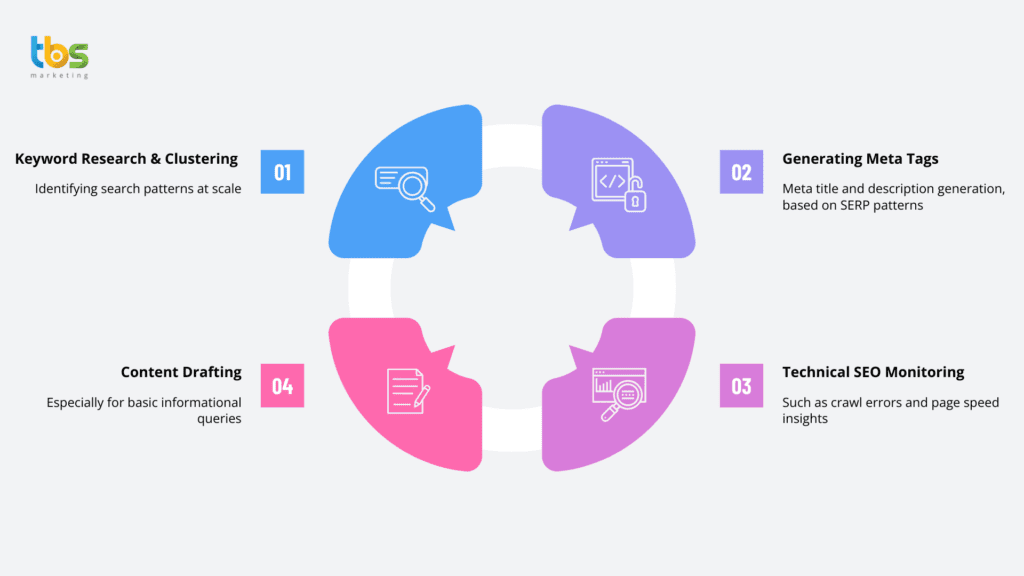
AI tools today are highly effective at:
- Keyword research and clustering, identifying search patterns at scale
- Content drafting, especially for basic informational queries
- Meta title and description generation, based on SERP patterns
- Technical SEO monitoring, such as crawl errors and page speed insights
According to RankTracker’s 2025 SEO statistics, over 86% of SEO professionals now use AI tools as part of their strategies, highlighting how widely AI has been adopted across the industry.
However, automation does not equal replacement. These tasks represent execution, not strategy.
What SEO Tasks AI Cannot Replace
While AI excels at efficiency, it struggles with context, intent nuance, and business alignment—areas where SEO still depends heavily on human expertise.
Strategic SEO Functions That Remain Human-Led

AI cannot fully replace:
- Search intent interpretation, especially for complex or ambiguous queries
- Brand voice and positioning, which require emotional and cultural awareness
- Content strategy and prioritization, tied to business goals
- UX-driven SEO decisions, such as information architecture and conversion flow
Google itself has stated that its ranking systems reward experience, expertise, authoritativeness, and trust (E-E-A-T), signals that are difficult for AI-generated content to demonstrate consistently without human input.
In other words, while AI can generate content, it cannot independently ensure that content deserves to rank.
The Rise of Generative Engine Optimization (GEO)
What Is GEO?
Generative Engine Optimization focuses on optimizing content so it can be:
- Cited by AI-generated answers
- Easily parsed by large language models
- Structured for factual clarity and trustworthiness
Unlike traditional SEO, which prioritizes rankings and clicks, GEO prioritizes visibility within AI responses.
How GEO Changes SEO Strategy
Key GEO tactics include:
- Clear definitions and concise explanations
- Structured data and schema markup
- FAQ-style formatting for answer extraction
- Strong topical authority signals
Rather than replacing SEO, GEO extends it, requiring marketers to optimize for both human users and AI systems.
The Future of SEO in the Next 3–5 Years
How SEO Roles Are Evolving
Future-ready SEO professionals are expected to:
- Use AI as a productivity multiplier, not a content shortcut
- Focus on strategy, analytics, and UX, not just keywords
- Optimize content ecosystems, not individual pages
- Measure success beyond rankings, including AI visibility and brand recall
A useful analogy is accounting software: calculators didn’t replace accountants. They eliminated manual math so professionals could focus on higher-level decision-making. SEO is following the same path.
Common Pitfalls Businesses Should Avoid
While AI-powered SEO offers advantages, misuse can lead to poor outcomes.
Risks of Over-Reliance on AI
- Publishing large volumes of low-value AI content
- Ignoring user intent in favor of keyword density
- Losing brand differentiation due to generic messaging
Google’s helpful content updates increasingly penalize content that appears automated, shallow, or disconnected from real user needs.
Conclusion
AI will not replace SEO, but it is fundamentally reshaping how SEO works. While AI can automate execution such as content drafting, analysis, and optimization, it cannot replace strategic thinking, brand understanding, or user intent interpretation. As search evolves toward AI-driven results and zero-click experiences, SEO is shifting away from pure keyword tactics and toward strategy, user experience, and visibility within generative search environments.
At TBS Marketing, we see AI as an enabler, not a replacement. Businesses that succeed will be those that combine AI efficiency with human expertise. The path forward is clear: embrace AI thoughtfully, invest in SEO expertise, and build strategies designed for both humans and intelligent machines.