

AI image generation has moved far beyond the novelty tools many businesses first tried in 2022. The useful question today is how to turn a visual idea into an image you can actually use, refine, and publish with confidence.
A strong workflow combines a clear brief, suitable reference material, careful editing, and human judgment. You might explore an illustration style, develop campaign concepts, or place a real product into a new setting. Each task needs different controls and a different standard of review.
This guide revisits the promotional mug example from our original article, explains what current image leaderboards can tell you, and shows how to use AI without confusing an impressive first result with finished artwork.
What has changed since the early AI art tools?
The biggest practical shift is the move from generating isolated pictures to working with images through successive edits. OpenAI’s Images 2.5 announcement describes improvements in following instructions and preserving details during changes. Google’s Nano Banana 2.1 documentation also lists image generation and multi-turn editing. These capabilities make iterative art direction a more useful starting point than collecting a long string of descriptive keywords.
Reference images are another part of that shift. Black Forest Labs documents workflows that combine source images for subjects, styling, and composition. Google also supports multiple image inputs. That gives you ways to communicate a visual requirement beyond describing it in words, although every result still needs checking against the reference.
For your next project, separate three jobs: exploring the idea, controlling the details, and preparing the final asset. You may use the same application throughout, or hand the chosen image to a designer for precise typography and finishing. Judge the workflow by the final result and the work needed to reach it.
Which AI image generators lead the latest rankings?
Two useful places to research image models are Arena and Artificial Analysis. Both publish rankings based on blind human comparisons. These scores describe preferences within their evaluations. They do not establish whether an image is accurate, suitable for your brand, or likely to improve campaign results.
The comparison below records Arena’s overall text-to-image board dated 7 October 2026 and the Artificial Analysis AA-Image-T2I v2.1 board retrieved on 15 October 2026. Model labels are shortened; their tested settings are explained underneath.
| Model / family | Arena: rank; score ± interval | Artificial Analysis: rank; Elo ± interval |
| GPT Image 2.5 Sunburst | 1; 1425 ±7 | 1; 1217 ±10 |
| GPT Image 2.5 Flare | 2; 1398 ±7 | 2; 1207 ±10 |
| GPT Image 2 | 3; 1383 ±4 | 3; 1187 ±12 |
| Grok Imagine Image 2.0 | 4 (canvas); 1334 ±12 | 5; 1166 ±13 |
| MAI-Image-2.6 | 5; 1332 ±5 | 6; 1164 ±12 |
| Nano Banana 2.1 | 6; 1328 ±9 | 4; 1172 ±12 |
Arena marks Sunburst, Flare, Nano Banana 2.1, and Grok’s canvas entry as preliminary. Artificial Analysis tests Sunburst and Flare at “max” and GPT Image 2 at “high”; Arena’s GPT Image 2 entry is “medium,” and its Grok entry is a distinct canvas configuration. These are comparisons of listed entries, not controlled tests of identical settings.
Treat nearby positions cautiously. Both boards publish uncertainty information, and their score scales differ. Do not average the Elo scores or read a score difference as a percentage improvement in image quality. Use the rankings to choose candidates for your own brief.
Image generation and image editing need separate tests
Artificial Analysis maintains a separate editing board. On the snapshot retrieved on 15 October 2026, its first five entries were GPT Image 2.5 Sunburst (max), GPT Image 2.5 Flare (max), MAI-Image-2.6, Nano Banana 2.1, and MAI-Image-2.6-Flash. Arena also separates image creation from editing, with distinct single-image and multi-image editing categories.
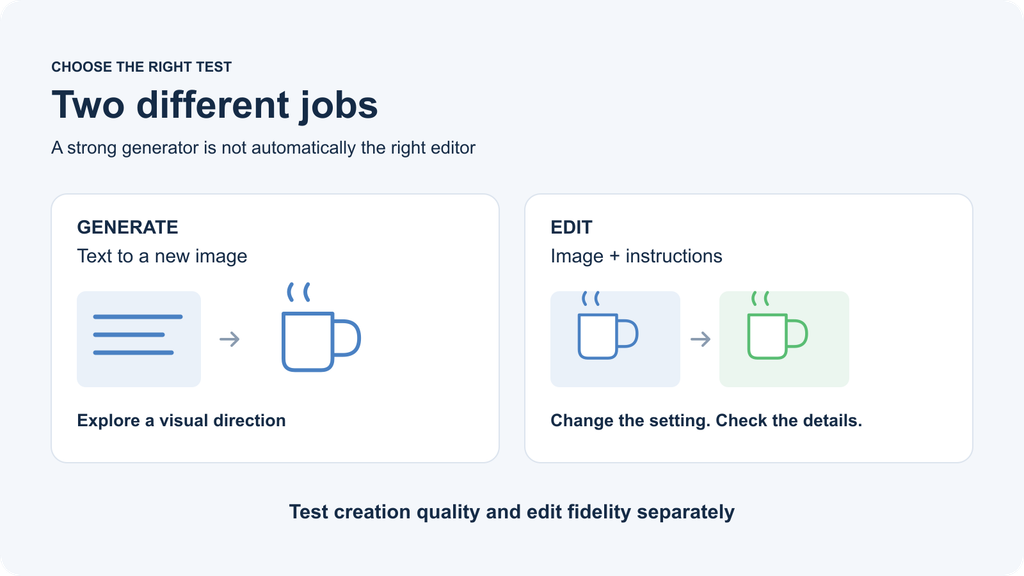
Figure 1. Generation creates a new image; editing changes an existing one. Evaluate both tasks separately.
For a product campaign, test whether a model preserves the shape, label, material, and proportions of the item after an edit. For an illustration project, test composition and visual consistency across the series. A beautiful generated scene can still fail the task if it changes the thing you need to show.
How to choose an AI image tool for your work
Start with one real assignment. Prepare the same brief and permitted reference images for two or three candidates. Compare their outputs without looking at the tool names, then record how many changes each result needs before you would approve it.
For concept art and visual exploration
Ask for genuinely different creative directions: a restrained editorial illustration, a bold geometric treatment, and a warm photographic scene, for example. Decide what each version communicates before refining details. Generating variations of an unclear idea can leave you with more choices and no stronger direction.
For product images and campaign assets
Use approved photographs when product identity matters. Assess the editor’s ability to keep the item intact while changing its surroundings. Keep a clean original beside every candidate so you can spot invented labels, altered handles, missing seams, or changes to packaging.
For established design workflows
Consider how easily the output moves into the tools your team already uses. Adobe describes Firefly as both a standalone service and a model family within Adobe applications, and states that its own models use licensed and public-domain training material. Check which model a feature actually uses before applying that statement to it.
Also compare practical costs: subscription or generation charges, time spent correcting outputs, export options, and approval effort. Avoid choosing purely by the advertised price of one generation. A useful internal measure is the total cost of producing an approved image.
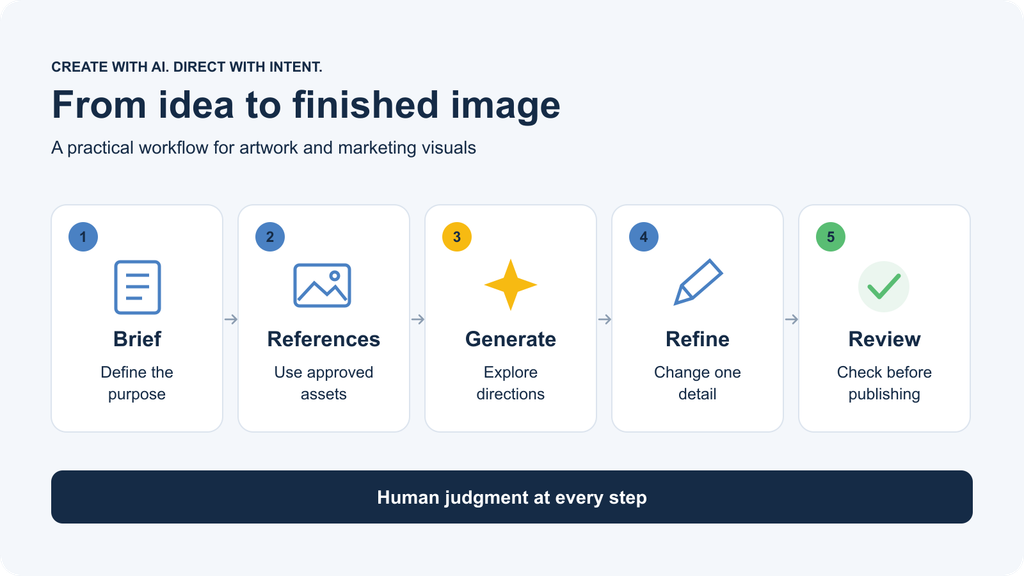
Figure 2. From brief to finished image: define the purpose, supply approved references, generate, refine, and review.
Five ways AI can support better artwork
1. Explore the visual direction before production
Use early images as discussion material. Show a client what “warm and approachable” means through palette, composition, and subject matter. Ask what feels right and what feels wrong. Keep the chosen direction with the brief so later decisions have a shared reference point.
2. Turn vague feedback into specific edits
Replace “make it more premium” with observable instructions: simplify the background, reduce the palette, soften the reflections, or create more space around the subject. Compare the edited version with the previous one before requesting another change. This makes approval decisions easier to explain.
3. Develop related assets with a shared brief
Document the palette, materials, lighting, composition, and prohibited elements for a series. Reuse that direction when creating related images, then review the set together. Do the images feel like one campaign? Repeated colours alone will not fix inconsistent product proportions or conflicting visual styles.
4. Plan images around their placement
A blog banner, product card, and portrait social graphic need different framing. Specify the intended placement before generating. Leave space where a headline or button will sit, and check the crop in the actual layout. For banners with overlaid text, use a darker overlay and check readability on mobile.
5. Make review part of the creative process
Inspect the image at full size and at its intended display size. Check lettering, object boundaries, reflections, repeated patterns, and the relationship between the subject and its surroundings. Ask a reviewer to compare it with the brief rather than simply vote on whether it looks attractive.
How to write a useful AI image prompt
Write a short creative brief in plain language. Include the subject, the image’s purpose, the composition, the setting, the lighting, the visual treatment, and any details that must remain unchanged. If you supply several references, explain the role of each one.
For example: “Use image one as the product reference and image two for the background palette. Create a calm office scene with the mug on the right and clear space on the left for a headline. Keep the mug’s proportions and handle shape unchanged.”
Describe the visual properties you want rather than relying on an artist’s name: textured gouache, muted earth tones, angular shapes, soft window light, or a limited colour palette. This also gives your team a clearer vocabulary for discussing revisions.
Resolution and aspect ratio are settings
The original article suggested adding “4K” to a prompt to obtain a high-resolution image. That is not a dependable way to set pixel dimensions. Google documents explicit size and aspect-ratio controls, while Black Forest Labs also specifies output-resolution capabilities for its models. Select supported settings and inspect the exported file.
Similarly, use the aspect-ratio control or syntax supported by your chosen application. A command copied from another tool may not work there. After export, check the width and height, the intended crop, and how the image looks at the size visitors will actually see.
A better promotional mug workflow
Our original example asked AI tools to invent a promotional mug from a text description. For a current business brief, start by deciding whether you need an imagined concept or a faithful representation of a product customers can buy. Label concept imagery clearly during review.

Figure 3. AI-generated product concept. This imagined mug illustrates rendering quality; it is not a photograph of an actual product or a test of reference-image fidelity.
Step 1: Prepare the reference
For a real product, use a clear photograph that you have permission to upload. Include the whole item, with an unobstructed handle and visible proportions. Supply the approved logo separately if your workflow allows it. Write down the details that reviewers must check.
Step 2: Generate the setting
Example prompt: “Create a landscape promotional scene using the supplied white ceramic mug as the product reference. Place it on the right side of an oak desk in a bright contemporary office. Use soft window light from the left and a gently blurred background. Keep the mug’s silhouette, handle, colour, and proportions unchanged. Leave uncluttered space on the left for a headline. Do not add lettering or extra products.”
Choose a supported landscape ratio in the application. This is an illustrative prompt, not a tested promise of exact preservation. Compare the generated mug with the original before accepting the scene.
Step 3: Refine one issue at a time
If the background is distracting, request a background change first. If the mug is too small, adjust its placement next. After each edit, check previously approved details again. Keep the strongest approved version so you can return to it if a later revision introduces new problems.
Step 4: Add exact brand elements
For production artwork, consider adding the final logo and headline in a design editor. Keep the logo from an approved source and make the typography editable. Inspect perspective and placement on the curved mug surface instead of assuming that an apparently plausible mark matches the supplied artwork.
Step 5: Review the finished placement
Preview the image in the banner or advert where it will appear. Check headline contrast, the mobile crop, product accuracy, and any impression the setting creates. A product image should help a customer understand the offer rather than create expectations the product cannot meet.
Commercial use, copyright, and responsible references
The original article’s suggestion that an image is automatically original or safe because you prompted it needs removing. Distinguish permission under a tool’s terms, rights in uploaded materials, and copyright protection for the resulting work. Do not assume those questions have the same answer.
In its January 2025 copyrightability report and accompanying announcement, the U.S. Copyright Office says prompts alone do not provide the human authorship needed for protection, while sufficient human creative contributions may qualify. That is a U.S. position, not a universal rule for every country or every image.
Before a commercial project, check the current terms for the particular model and plan you use. Confirm permission for reference photographs and other supplied assets. For a valuable commission or exclusive brand asset, get advice appropriate to the jurisdiction and retain records of the human creative work.
Keep a simple project record: the approved brief, reference sources, model and settings, selected outputs, substantive edits, and final approval. Avoid uploading confidential client material until your team has checked the service’s data-handling terms. These are practical review steps, not a promise that any workflow eliminates rights disputes.
Frequently asked questions
What is the best AI image generator right now?
The dated leaderboard snapshots above identify current leading entries. Use them to build a shortlist, then test your own assignment. An overall preference ranking does not decide which tool best preserves your product or fits your editing process.
Do I need a powerful computer?
You do not need to install a model locally to use the browser-based services described by OpenAI and Black Forest Labs. If you want a local workflow, check the exact model’s hardware requirements and licence before choosing equipment. The original article’s blanket graphics-card recommendation should not guide a current purchase.
Can AI replace a product photoshoot?
For a concept, an imagined product may be enough. For an actual sales listing, assess every detail against the item being sold. Use a real product photograph or a reviewed composite whenever the generated version changes features that matter to the customer.
Will AI replace human artists?
Image capabilities alone cannot settle that prediction. For a business project, assign responsibility for art direction, selection, accuracy, finishing, and approval. Decide where AI supports those tasks and where a commissioned artist or designer provides the judgment and authorship you need.
Develop your next visual brief with TBS Marketing
Need help turning an image idea into campaign artwork? Contact TBS Marketing to discuss the audience, placement, product references, and review requirements for your next AI Image generation project.
Which part of your image workflow needs the most attention: finding the idea, preserving product details, or preparing the final design?