
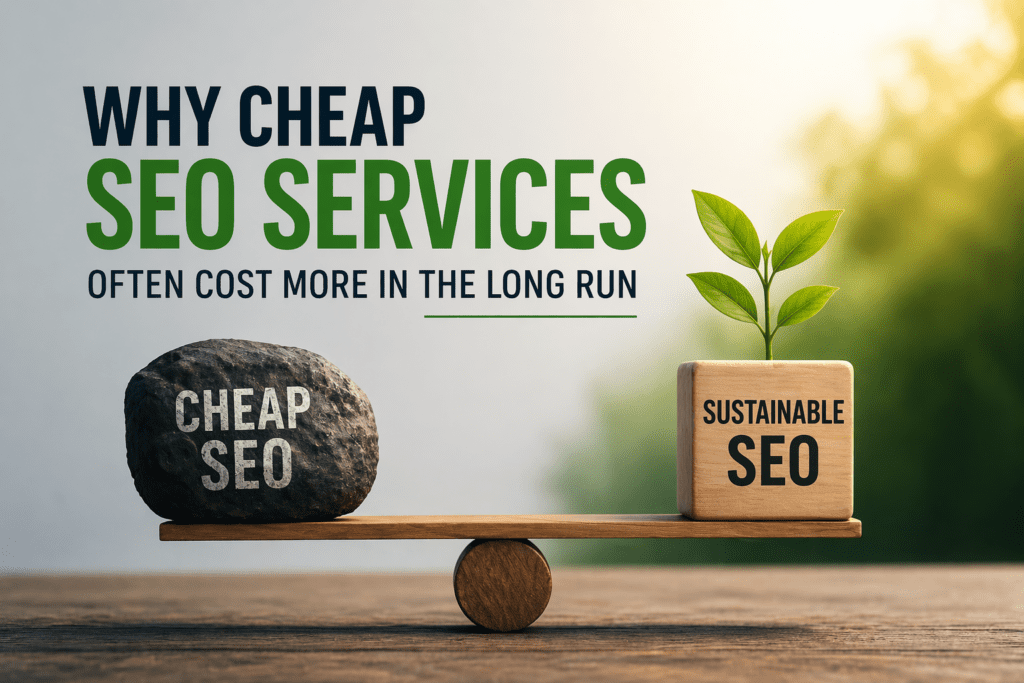
Cheap SEO services often appear cost-effective because they promise fast rankings at a low monthly fee, but they frequently create larger financial and reputational losses over time. According to Google, websites using manipulative SEO tactics such as spam links, keyword stuffing, and low-quality content risk manual penalties and long-term ranking loss, which can take months or years to recover from.
A 2024 report by Ahrefs found that over 96% of web pages receive no organic traffic from Google, showing how difficult sustainable SEO growth actually is when strategy and quality are missing. Businesses that choose low-cost SEO providers often pay twice—first for poor execution, and later for recovery.
This article explains why cheap SEO services often become expensive in the long run, how low-cost SEO providers cut corners, what risks businesses face, and how to evaluate SEO investment based on ROI rather than monthly pricing.
What Are Cheap SEO Services?
Cheap SEO services are low-cost SEO packages that prioritize price over long-term performance.
Cheap SEO services usually offer fixed monthly pricing significantly below market standards, often including guaranteed rankings, bulk backlinks, automated reports, and high-volume content production with minimal strategic work.
These services commonly include:
- Low-cost backlink building
- Automated keyword insertion
- AI-generated or spun content
- Generic monthly reporting
- Mass directory submissions
- Minimal technical SEO audits
While these deliverables may look productive on paper, they often fail to align with search intent, technical health, or sustainable authority building.
In contrast, strategic SEO requires:
| SEO Area | Cheap SEO Approach | Strategic SEO Approach |
| Content | Quantity-first | Intent-first |
| Links | Bulk link buying | Authority-based link earning |
| Technical SEO | Minimal checks | Full performance optimization |
| Reporting | Vanity metrics | Revenue-focused KPIs |
| Strategy | Template-based | Business-specific planning |
Why Cheap SEO Services Usually Fail
Cheap SEO services fail because sustainable SEO requires expertise, time, and high-quality execution.
SEO is not a low-labor service. Effective SEO involves technical audits, content planning, competitor analysis, link acquisition, UX optimization, and continuous performance refinement.
According to Backlinko, pages ranking on page one of Google typically have significantly stronger backlink profiles, better topical depth, and stronger user engagement signals than lower-ranking pages.
Low-cost providers reduce operational costs by removing the most expensive parts of SEO:
They Replace Strategy With Templates
Most cheap agencies apply identical SEO packages across every client regardless of industry, competition level, or buyer journey.
This creates problems such as:
- irrelevant keywords
- weak conversion paths
- duplicate content structures
- missed local SEO opportunities
They Prioritize Short-Term Ranking Signals
Some providers focus only on ranking movement instead of revenue generation.
This includes:
- targeting zero-conversion keywords
- creating thin content pages
- purchasing low-authority backlinks
- over-optimized anchor text
These tactics may create temporary ranking spikes, but often damage long-term domain trust.
How Cheap SEO Creates Hidden Costs
Cheap SEO often increases future costs by creating technical debt and recovery expenses.
The real cost of cheap SEO is rarely the monthly invoice. It appears later through ranking loss, traffic decline, wasted content budgets, and reputation damage.
Google Penalties Are Expensive to Fix
Google actively penalizes manipulative SEO practices through algorithm updates and manual actions.
Common triggers include:
- unnatural backlink profiles
- doorway pages
- duplicate content
- cloaking
- hidden text
- spam automation
Recovery may require:
- link audits
- disavow files
- content deletion
- technical cleanup
- reconsideration requests
This process often costs significantly more than proper SEO implementation from the start.
Poor Content Wastes Marketing Budgets
Low-quality SEO content often needs full replacement.
Instead of improving authority, it creates:
- poor engagement metrics
- weak brand trust
- lower conversion rates
- content cannibalization
A business may spend months publishing content that generates no pipeline value.
Lost Time Equals Lost Revenue
SEO compounds over time, which means strong execution creates increasing returns as rankings, authority, and visibility grow month after month. When businesses spend six months on ineffective SEO, that growth is delayed while competitors continue building stronger domain authority, earning more quality backlinks, publishing more indexed content, and increasing branded search demand. By the time poor SEO performance is recognized, competitors often hold a much stronger position in search results, making recovery significantly harder and more expensive. In many cases, the lost revenue and missed market opportunities cost far more than the original service fee itself.
Why Some Businesses Still Choose Cheap SEO
Cheap SEO remains attractive because pricing is easier to compare than strategic quality.
Many business owners evaluate SEO like a commodity purchase rather than a growth system.
Common reasons include:
SEO Results Are Difficult to Measure Early
Unlike paid ads, SEO ROI is delayed.
This makes offers like:
- “Guaranteed #1 rankings”
- “500 backlinks per month”
- “Fast SEO results”
appear attractive, even when they signal poor practice.
Procurement Often Focuses on Lowest Price
Internal purchasing teams may compare agencies using monthly retainers instead of revenue outcomes.
This creates a false comparison:
$300/month SEO vs $2,500/month SEO
instead of:
$300/month low-value work vs long-term revenue growth
Lower price feels safer initially, but frequently creates larger downstream costs.
How to Evaluate SEO by ROI Instead of Price
SEO should be evaluated based on business outcomes, not monthly retainers.
The right question is not “How much does SEO cost?” but “What does poor SEO cost?”
Look for Revenue Metrics, Not Ranking Promises
Strong SEO providers discuss:
- lead quality
- organic conversion rates
- customer acquisition cost
- branded search growth
- sales attribution
- content-assisted revenue
Weak providers focus only on:
- ranking screenshots
- traffic without conversion data
- backlink volume
- fixed package outputs
Ask About Process, Not Just Deliverables
A trustworthy SEO partner should clearly explain:
- keyword qualification
- technical audit depth
- content strategy methodology
- link acquisition standards
- reporting tied to business goals
If the agency cannot explain the process, low pricing is usually covering low-quality execution.
When Lower-Cost SEO Can Still Work
Lower-cost SEO can still be effective when the reduced price comes from a clearly limited scope rather than weak strategy or poor execution. Not all affordable SEO services are harmful—many businesses, especially smaller companies or local brands, can benefit from focused SEO support without committing to large monthly retainers. The key difference is transparency. Affordable SEO works when both the provider and the client clearly understand what is included, what results are realistic, and how quality will be maintained throughout the process.
For example, lower-cost SEO can be valuable for:
- local SEO for a single-location business
- technical SEO audits without ongoing monthly retainers
- content optimization for existing high-value pages
- SEO consulting for internal marketing teams managing execution in-house
In these cases, pricing stays lower because the project scope is controlled, not because important SEO work is being skipped. Businesses can still achieve meaningful results when expectations are realistic, deliverables are clearly defined, and quality standards remain high.
Cheap SEO becomes dangerous when low pricing is achieved through shortcuts such as spam backlinks, thin content, automated reporting, or generic strategy templates. The issue is not affordability itself, but whether the lower price reflects efficient scope management or poor-quality execution that creates larger costs later.
Cheap SEO vs Sustainable SEO: The Real Business Decision
The decision is not simply cheap SEO versus expensive SEO, but short-term savings versus long-term digital marketing growth. Businesses that view SEO as a strategic part of their digital marketing strategy invest in long-term authority, trust, and compounding visibility across search engines. In contrast, businesses that treat SEO as a low-cost checkbox often end up paying more for penalty recovery, content replacement, and lost revenue opportunities.
The more important question is whether your SEO investment is building a long-term business asset or creating a future liability. Sustainable SEO strengthens brand credibility, improves organic lead generation, and supports broader digital marketing performance across content, paid media, and conversion funnels.
At TBS Marketing, SEO is approached as part of a complete digital marketing strategy not as an isolated monthly service. This means focusing on technical performance, content quality, search intent, and authority building that supports measurable business growth over time.
That distinction determines whether SEO becomes a reliable growth channel or a recurring recovery project. For businesses evaluating long-term search visibility, understanding how SEO compounds alongside authority, content depth, and trust signals is the next strategic step toward sustainable digital marketing success.