
At TBS Marketing Agency, we often hear the same question from new clients: “Why cannot we rank on Google next month?” The answer lies in how search engines actually work. SEO is not broken, it is engineered to reward sustained effort over quick wins because SEO is not something that can be switched off and on. Unlike paid ads that disappear when your budget runs out, SEO builds permanent assets that compound over time.
This article explains why quality SEO takes 3 to 18 months, what is happening behind the scenes during that wait, and why that deliberate pace protects your business and delivers superior long-term returns.
What Is the SEO Timeline?
The SEO timeline is the natural maturation period between implementing optimisation strategies and achieving stable, high-value rankings. Think of it like planting an orchard rather than buying fruit at the store. You are not purchasing visibility; you are cultivating authority that produces results season after season.
This timeline typically breaks down into three distinct phases:
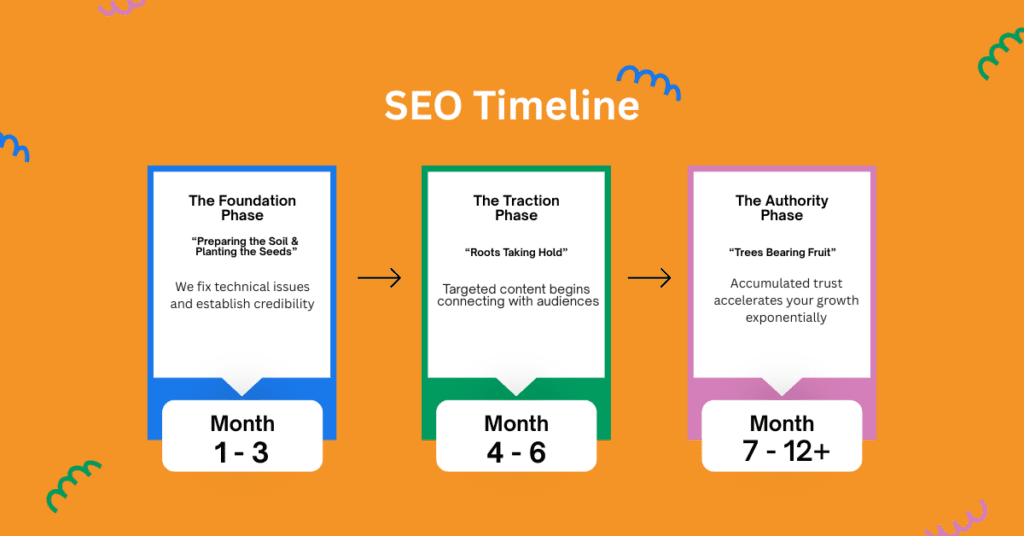
Each phase serves a specific purpose in convincing Google that your site deserves permanent placement at the top.
Why Google Forces SEO to Take Time
Search engines delay rankings deliberately to protect search quality. Google’s algorithms operate on a simple principle: trust must be earned, not purchased.
When we optimise a new page, Google initiates a “probation period” called the Rank Transition Algorithm (an informal 1-3 month period where Google observes whether you are building a legitimate resource or a fly-by-night operation). For approximately 90 days, Google intentionally fluctuates your rankings, moving you up and down unpredictably. This is not random cruelty; it is a security measure. By observing how you behave during volatility (whether you panic and resort to spam tactics or maintain quality), Google filters out businesses looking for shortcuts. Search Engine Land explains this process as Google’s way of preventing manipulation. If rankings changed instantly, spammers could game the system overnight.
During this time, Ahrefs notes that Google evaluates your content’s “stickiness” (whether users find genuine value or quickly bounce back to search results). This behavioural analysis simply cannot be rushed.
What Actually Happens During the Wait
Understanding the mechanics helps explain the timeline. Here is what TBS Marketing Agency executes while results appear “stuck”.
Months 1-3: Technical Infrastructure
We are repairing the foundation. Google’s crawlers (automated programmes that read websites) must access, understand, and catalogue every page. If your site loads slowly, lacks mobile optimisation, or contains broken links, crawlers waste your “crawl budget” and leave before indexing your best content. We fix these mechanical issues so Google can efficiently read your site, but this backstage work shows no immediate ranking changes.
Months 4-6: Content Maturation
Your articles enter what we call the “ageing period”. Google does not trust fresh content immediately because the internet is flooded with overnight posts that lack depth. The algorithm waits to see if your content earns genuine backlinks (other sites referencing you as an authority) and maintains user engagement over time. Ahrefs found that content typically requires 100 days to reach peak traffic as Google monitors these trust signals.
Months 7-12: The Compounding Effect
Once Google confirms your site delivers consistent value, something shifts. Your domain authority (the accumulated trust you have built) begins working for you. New content ranks faster because you have proven your expertise. Existing articles climb higher as they collect engagement data. This is where patience pays exponentially, as each piece of content amplifies the others, creating a self-reinforcing cycle of visibility.
Why Rushing Destroys Results
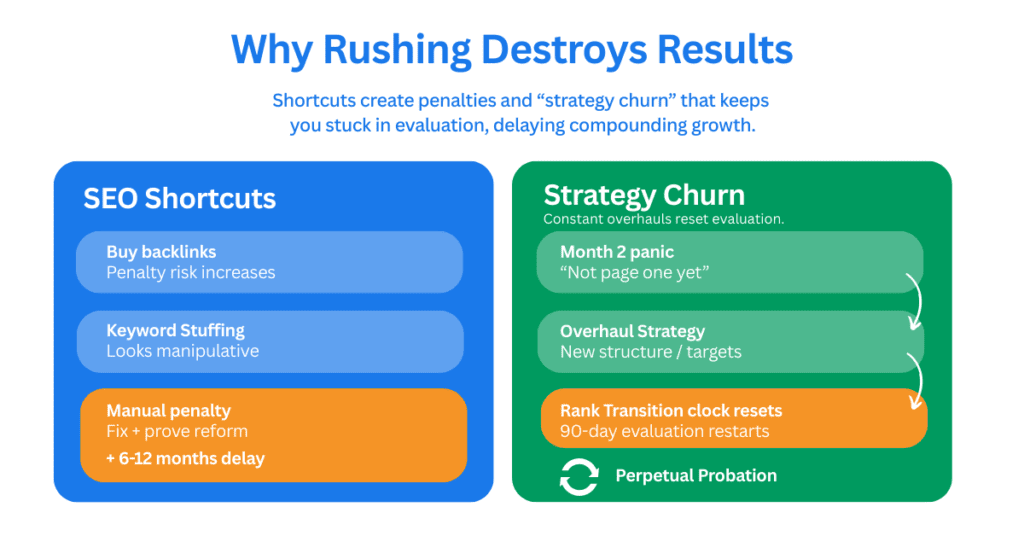
Attempting to accelerate SEO through shortcuts does not just fail; it actively damages your timeline. When businesses buy backlinks or stuff keywords to game the algorithm, they trigger manual penalties. Recovery from these penalties requires not just fixing the issue, but proving you have reformed, typically adding 6-12 months of delay.
Furthermore, constantly changing strategies resets your Rank Transition clock. If you panic at month two and overhaul your approach because you have not hit page one, Google restarts its 90-day evaluation period. This “strategy churn” traps businesses in perpetual probation, never allowing the compounding phase to begin.
Conclusion
SEO takes 3 to 18 months because Google designed it that way: to reward legitimate authority building and punish manipulation. At TBS Marketing Agency, we view this not as a limitation, but as a competitive advantage. While competitors chase quick wins and burn out, our clients build permanent assets that dominate search results for years.
The delay creates a moat around your business. Once established, your rankings become self-sustaining, delivering consistent ROI that outperforms paid advertising without ongoing per-click costs.
Want to deepen your understanding of how SEO really works? Explore our in-depth guides on building lasting search authority: learn why SEO cannot be treated as an on-off switch, discover how semantic search is reshaping rankings, or master the content strategies that satisfy Google’s E-A-T requirements. For the complete picture, check out our SEO in 2025: The Complete Guide.